
Rev. 2025
Wisconsin Disaster Fund Coordinator
Email: widisasterfund@widma.gov
Office:608-242-3259
Fax:608-242-6525
Contents
- Introduction
- Eligibility Criteria
- Per Capita Threshold
- Incident Period
- Eligible Costs
- Work performed by Electrical Cooperatives
- Snow Assistance
- Ineligible Costs
- Third-Party Costs
- Application Process
- County and Tribal Responsibility
- Within 30 days From the End of the Incident
- Applicant Responsibility
- EM GRANTS PRO
- Communication
- Application Submittal Requirements and Review
- Initial Application Requirements (Pro Step 1 to 2)
- Damage Description Requirements
- Review of Initial Application (Pro Step 2 to 3)
- Final Application Requirements (Pro Step 3 to 4)
- Final Application Review (Pro Step 4 to 5)
- Approval Documents
- Payment
- Supporting Documentation Requirements
- Labor Costs
- Category A Debris Clearance (Emergency Work)
- Category B Protective Measures (Emergency Work)
- Category C Publicly Owned Roads and Bridges (Permanent Work)
- Equipment Usage Costs
- Material Costs
- Rental Equipment Costs
- Contract Work Costs
- Donated Resources
- Volunteer Fire Departments
- Time Extensions
- Denials
- Appeals
- Appendices
- Appendix A – Damage Description Minimum Requirements Table
- Minimum Requirements For a Completed Damage Description
- Example of a Completed Damage Description
- Appendix B – EM Grants Pro Application flow chart
Introduction
The Wisconsin Disaster Fund (WDF) is a state-funded program designed to reimburse local governmental units, federally-recognized tribes and bands, and retail electric cooperatives – hereafter referred to as Applicants – for costs incurred by a disaster when Federal Emergency Management Agency (FEMA) Public Assistance funding is not available. The program is authorized by 323.31, Wis. Stats., and governed by Chapter WEM 7 of the administrative code.
WDF is modeled after FEMA’s Public Assistance Program and aligned with FEMA’s guidance where possible. The program is also guided by the Robert T. Stafford Disaster Relief and Emergency Assistance Act. However, WDF is more limited in scope. Therefore, the fund does not cover losses suffered by individuals, businesses, or the agricultural sector.
This handbook contains the required administrative procedures, references, and guidance that will assist in the application process for WDF reimbursement. WDF is a reimbursement program based on eligible, documented costs that were caused by a disaster. Accurate records are essential in documenting the costs of disaster recovery and are necessary to support a WDF claim.
Eligibility Criteria
The Applicant must meet all of the following criteria to be eligible to receive WDF reimbursement:
- The Applicant is a local governmental unit, which includes counties, cities, villages, and towns, local retail electrical cooperatives and federally recognized tribal governments.
- The Applicant suffered a disaster, defined as a severe or prolonged, natural or human-caused, occurrence that threatens or negatively impacts life, health, property, infrastructure, the environment, the security of the state or a portion of the state or critical systems, including computer, telecommunications, or agricultural systems.
- The Applicant incurred costs as a direct result of the disaster that are equal to or exceed a per capita damage threshold.
- Federal disaster assistance is not available to the Applicant because either:
- The state did not meet eligibility thresholds for federal assistance, or
- The state did achieve eligibility, but the local governmental unit does not reside within a federally declared county.
PER CAPITA THRESHOLD
The damage threshold is determined by the Consumer Price Index on October 1 of each year. For 2025, the threshold is $4.72 per capita. For example, a town of 2,000 residents would have to incur $9,440.00 or more in damages (2,000 x $4.72).
The damage threshold is calculated using the following population figures:
- Local governmental units: the 2020 US Census values.
- Retail electrical cooperatives: The population served by the electrical cooperative at the start of the disaster incident period, as determined through connections, customers, accounts, or other definable means from within each of the affected counties. The damage threshold must be met separately for each affected county to be eligible for WDF. Only one application is necessary.
- Tribal governments: The number of enrolled members at the start of the incident period.
INCIDENT PERIOD
All disasters have a start and end date, which is defined as the incident period. The incident period is determined by WEM for each disaster and can vary depending on specific criteria. For example:
- For most severe weather disasters, the incident period starts when the storm enters the state and ends when the storm exits the state. Successive storm systems separated by more than 72 hours are considered separate storm systems.
- For most flooding disasters, the incident period ends when the river gauges are no longer in Major Flood stage.
WEM works with industry experts such as the National Weather Service (NWS) and considers a variety of data sources when determining the incident period start and end date. FEMA guidance documentation is also considered.
ELIGIBLE COSTS
To be eligible for WDF, costs must be the direct result of the disaster, have occurred during the designated incident period, and be the legal responsibility of the eligible Applicant at the time of the disaster. Eligible costs also must fall within the three following categories of work:
- Category A – Debris Clearance to include woody debris, stump grinding, dirt to fill stump holes, building wreckage, work to clear public roads, and debris placed on roadside for pickup. The debris must be causing or have the potential of causing an immediate threat to life and safety on improved property to be considered eligible.
- Category B – Emergency Protective Measures to eliminate or reduce immediate threats to life, public health or safety, or a hazard that threatens significant damage to improved public or private property within five years of the disaster. Examples of emergency protective measures include sandbagging for water control or road closure services.
- Category C – Roads and Bridges to include surfaces, bases, shoulders, ditches, drainage structures, culverts, piers, girders, abutments, slope protection and approaches.
- Roads are eligible for repair if they do not receive federal funds for maintenance. Roads that do not receive federal funds for maintenance are typically rural major roads, rural minor roads, and rural local roads. See the Wisconsin DOT webpage on Functional Classification to determine road classification by county, (https://wisconsindot.gov/Pages/projects/data-plan/plan-res/function.aspx).
- Access roads, service roads, driveways, and private roads, including homeowners’ association roads, are not eligible for this program. Roads owned by a Tribal government may be eligible for the WDF even if the roads are not open to the general public.
- Road damage that resulted from debris removal or other emergency work, i.e., heavy machinery operating on roadways to clear debris, may be reimbursable if the damage was based on the necessity to use the road for debris removal or other emergency work. An Applicant may be required to provide maintenance records to document prior conditions of the road.
- Eligible culverts must be part of an eligible rural road, functional prior to the event, and if damaged during the event, replaced in-kind. An Applicant may be required to provide maintenance records to document prior conditions of the culvert.
WORK PERFORMED BY ELECTRICAL COOPERATIVES
In addition to the previous section on the general eligible costs, electrical cooperatives are subject to the following eligibility requirements:
- Category A Debris Clearance:
- The cooperative may need to clear debris out of the right-of-way (ROW) to obtain access to the damaged facility. Only costs related to clearing the ROW are eligible under Category A
- If the facility completely removes the debris initially, it would be considered Category A work.
- If any trees in the vicinity of the facility were damaged during the disaster and an arborist confirms that the tree is an immediate threat to the overhead lines or other portions of the facility, they would be considered Category A work.
- The cooperative may need to clear debris out of the right-of-way (ROW) to obtain access to the damaged facility. Only costs related to clearing the ROW are eligible under Category A
- Category B Protective Services:
- Only the emergency protective measures to address immediate threats to life, health or safety and to restore the disaster damaged facility back to pre-disaster condition are eligible. This includes costs from the following areas necessary to restore power and repair the damaged facilities back to pre-disaster conditions until the power has been restored.
- Employee overtime,
- Equipment usage costs,
- Materials,
- Rental equipment, and
- Contract work.
- Only the emergency protective measures to address immediate threats to life, health or safety and to restore the disaster damaged facility back to pre-disaster condition are eligible. This includes costs from the following areas necessary to restore power and repair the damaged facilities back to pre-disaster conditions until the power has been restored.
SNOW ASSISTANCE
Snow-related activities, including snow removal, snow dumps, de-icing, salting, and sanding of roads and other eligible facilities are only an eligible emergency protective measure when a winter storm results in record or near-record snowfall. For these activities to qualify, a county must be within 10% or exceed the highest record snowfall within the county for either a 1-, 2-, or 3-day period. Information about the records can be found at the National Centers for Environmental Information site1. WDF works with the NWS to verify snowfall totals.
If the disaster does not meet the snowfall threshold, costs associated with snow-related activities are ineligible for reimbursement or to go towards the applicant’s costs to determine if the damage threshold is met or exceeded. EXCEPTION: limited-snow related activities necessary to carry out emergency protective measures, such as clearing snow in the immediate area of a downed powerline that is owned and maintained by an eligible applicant, this does not include snow removal of entire road sections.
1 https://www.ncdc.noaa.gov/snow-and-ice/snowfall-extremes/WI
INELIGIBLE COSTS
Below is a list of commonly encountered items which are ineligible for reimbursement under WDF. Ineligible work and costs include, but are not limited to:
- Damage to water control facilities including dams, reservoirs, levees, drainage channels, shore protective devices, irrigation facilities, structures outside the eligible road right-of-way and pumping facilities.
- Damage to buildings and equipment.
- Damage to power generation facilities, other than damage covered under Categories A and B as described above.
- Damage to sewage collection systems and water treatment plants.
- Lodging and travel expenses2.
- Fuel or gas for Applicant owned, volunteer owned, or rental equipment.
- Purchase of new equipment, repair or maintenance of equipment or vehicles.
- Purchase of supplies not exhausted during the response phase of the disaster, some examples include but are not limited to gas tanks, small tools, clipboards, coolers, signage, etc.
- Ordinary operating expenses of local governmental units, such as salaries and expenses of public elected officials, which are not directly related to the disaster and not part of their required duties.
- Local government payments or subsidies to individuals or businesses for disaster-related costs.
- Administrative overhead costs associated with disaster response and recovery, including the time to gather and submit the application documents.
- Costs for which payment has been, or will be, received from any other funding source.
- Disaster-related costs which should be covered and compensated for by insurance.
- Applications with eligible damages totaling less than $500.00.
- Mitigation and/or improvement projects. Roads and associated structures must be restored to pre-disaster condition only.
- Assistance provided under written or verbal mutual aid agreements that are not billed to the recipient jurisdiction.
- Costs associated with snow removal, except as described above.
- Interest incurred on loans for disaster recovery work.
- Donations provided by the jurisdiction to volunteers assisting with the disaster response and recovery.
2 In some limited cases, some transportation costs (i.e. ferry costs) may be eligible as long as they are reasonable and can be justified. For example, ferry costs associated with contractor transportation to Washington Island or Madeline Island to perform storm related activities for the specific disaster event.
THIRD-PARTY COSTS
Applicants that have costs that may be reimbursable through another source, such as insurance, a responsible party, or another governmental program, may be required to seek reimbursement through these other sources before WDF reimbursement can be approved.
If an Applicant anticipates that costs may be recoverable through a third party, the Applicant must still submit a WDF application with supporting documentation to be considered eligible if costs are not recovered through the third party. The Applicant may request an extension until any third-party considerations are resolved.
APPLICATION PROCESS
The application process for WDF has two stages. The first is completed by the county/tribal emergency manager within 30 days and the second stage is completed by the applicant within EM Grants Pro (“Pro”) within 60 days of the end of the incident. The Applicant will then have 30 days to submit any additional required information or documentation.
Time After Disaster Starts
Within 30 days of the end of the incident period
Task Item(s)
County/Tribal EM submits via email:
- County/Tribal Notification form
Within 60 days of the end of the incident period
Task Item(s)
Eligible applicants submit via Pro:
- Application with Worksheet(s)
- Damage Description Information
- Cost estimates (Actual incurred and/or estimated)
Within 30 days of notification by WEM
Task Item(s)
Eligible applicants submit via Pro:
- Signed Assurances
- Corrections to submitted Worksheet(s)
- Supporting documentation for claimed costs
- OR Time Extension Request
COUNTY AND TRIBAL RESPONSIBILITY
Within 72 hours of the start of a disaster, it is recommended that the County or Tribal Emergency Management (EM) Director submits a Uniform Disaster Situation Report (UDSR) through WebEOC. Only one UDSR should be submitted for the entire county or tribe for a specific disaster. Updates to the UDSR should be made to the original UDSR as necessary to reflect situational changes. The UDSR provides rough damage estimates to both private and public areas that may be affected. These estimates are used to determine possible funding options to support the state due to the severity of the disaster. The damage estimates should be separated by category of work. Applicants can refer to the Damage Assessment Guidance webpage for additional information.
WITHIN 30 DAYS FROM THE END OF THE INCIDENT.
Within 30 days of the end of an incident period, the County or Tribal EM must submit the Notification to WEM of Eligible Applicants for Wisconsin Disaster Fund (referred to as the County/Tribal Notification Form) via email, which lists potential applicants (jurisdictions that plan on completing a WDF application), their damage estimates3, and their population totals to determine whether each applicant meets the per capita and minimum damage thresholds. Only one County/Tribal Notification form should be submitted for the entire county or Tribe. Individual County/Tribal Notification forms should not be submitted for each applicant. Tribal applicants may either submit their information on their own form or include their estimates on a neighboring county’s form.
Upon receipt of the County/Tribal Notification form, the WDF Coordinator will verify each of the listed applicants for eligibility. All applicants listed on the County/Tribal Notification will be set up within Pro.4 If they do not have an existing Pro account, the eligible potential applicants will receive an email to finish setting up their account from noreply@emgrants.wi.gov. The WDF Coordinator will also send a separate email that outlines the future deadlines and supporting documentation to complete or is designed to assist with submitting the application and final documentation if an applicant decides to proceed with WDF reimbursement. Applicants should establish contact with the WDF Coordinator early to facilitate the application process. Ineligible potential applicants will receive written notification explaining why they are ineligible for WDF reimbursement.
Electrical Cooperatives: Cooperatives must submit documentation on how the population was determined with the County/Tribal Notification form. Electrical cooperatives must determine their population within their service area as connections, customers, accounts, or other definable means from within each of the affected counties. The population must be separated by county and the damage threshold must be met separately for each affected county to be eligible for WDF.
Road Damage: If there has been severe damage to roads, contact should be made as soon as possible with the Wisconsin Department of Transportation (WI-DOT)’s Disaster Damage Aids (DDA) program personnel (https://wisconsindot.gov/Pages/doing-bus/local-gov/astnce-pgms/highway/disaster.aspx). Costs may be eligible for this program, which offers a better cost-sharing rate allows for mitigation and/or improvements beyond pre-disaster condition. The County Highway Commissioner acts as a liaison between the local applicant and the DDA program. County and Tribal EMs should inform applicants of both the WDF and DDA programs and encourage them to proceed with the best available option.
3 These estimates should not include any mitigation efforts or permits and should only include damages that were incurred during the incident period. Applicants should also refer to the Eligible and Ineligible items section within this document.
4 If a jurisdiction is listed on a notification form and is still under threshold after the due date elapses, then they are still ineligible. If additional costs are determined and they seek to try again with a WDF application, they would need to submit an appeal through EM Grants Pro.
APPLICANT RESPONSIBILITY
Within 60 days of the end of the incident period, eligible applicants identified on the submitted County/Tribal Notification form must submit the application, damage assessment information, and supporting documentation in EM Grants Pro (“Pro”). This information is the responsibility of the applicant, not a county or consultant’s, to collect and submit. Applicants can refer to the EM Grants Pro Application flow chart for a visual representation of the application and review process. For application submittal and review, refer to the Application Submittal Requirements and Review section.
EM GRANTS PRO
WEM uses Pro to manage WDF. The web-based site, located at https://emgrants.wi.gov/, is used for the management of WDF reimbursements from application submittal through closeout.
Applicants use Pro to:
- Submit applications and damage descriptions
- Outline claimed damage costs
- Upload damage descriptions, supporting documentation and photos
- Sign and submit the Assurances and DMA 1017
- Submit Time Extension Requests
- Submit Appeal Requests
WEM/WDF Coordinator uses Pro to:
- Review submitted application and damage descriptions
- Validate claimed costs
- Request payment
- Process submitted forms signed by the applicant
For assistance in working in the EM Grants Pro system, applicants can refer to the WEM-WDF Webpage (https://wem.wi.gov/recovery/wisconsin-disaster-fund-wdf/) for a walkthrough video (Wisconsin Disaster Fund (WDF) & EM Grants Pro Walkthrough) and written documentation.
COMMUNICATION
Once the applicant starts a draft application within Pro, they are able to send notes through the system to the WDF Coordinator or other contacts with permissions within Pro for their jurisdiction. From this point until the application is closed, Pro is the main communication tool that the WDF Coordinator will use to communicate with the applicant point of contact(s). Applicants should make sure that the email address noreply@emgrants.wi.gov is enabled as a safe email address so this communication does not go to the point of contact’s junk or spam mailboxes. The WDF Coordinator may also send emails, phone calls and paper memos during the application vetting, approval and payment process.
APPLICATION SUBMITTAL REQUIREMENTS AND REVIEW
The EM Grants Pro Application flow chart provides a visual representation of the application and review process which is outlined below. The application submittal through Pro is a multi-stage process with an initial application and then the final version when all of the completed work and documentation is provided.
INITIAL APPLICATION REQUIREMENTS (PRO STEP 1 TO 2)
The initial application submitted within 60-days of the end of the incident period must include the following information. This section starts Pro Step 1 where the applicant contact(s) create a draft application and submit it, which moves the application to Pro Step 2. When the application is submitted, all response and/or recovery work does not need to be completed nor do all of the final invoices need to be submitted. Costs need to at least be provided as estimates if actual costs are not available at the time.
- Contact selection for at least the Primary contact.
- Scope of Work
- At least one Worksheet for listing the claimed line items for damages. More than one worksheet may be needed depending on the quantity and type of damage. The required areas on the worksheet include:
- Site/Facility Intro
- Site/worksheet name
- Damage Description –If applicants are supplying at least the minimum damage description information on separate documentation, they can enter “see attached file” and include the file name. See the Damage Description Requirements section for additional information.
- Scope of Work for both work completed and work yet to be completed at the time of the initial application submittal.
- If any donated resources are to be claimed, they must be entered into a separate worksheet.
- If costs are known, enter the claimed costs into the worksheet as Individual Line Entries, not Lump Sums. Costs should be separated by category of work. Applicants can refer to the Eligible and Ineligible Costs section on how these can be separated.
- Initial applications may be submitted without costs if they are unknown at the time of submittal. Costs must be provided before an application is accepted and moved from Pro Step 2.
- Any supporting documentation may be uploaded with the initial application if it is available but is not required at this step. When the initial application is reviewed, the WDF Coordinator reviews all supplied information and will include any additional documentation to be submitted with the final review in the advance notification note.
- Site/Facility Intro
DAMAGE DESCRIPTION REQUIREMENTS
A damage description provides the location, type of damage, dimensions of damage, and work necessary to bring the damaged area back to pre-disaster condition for each of the areas in which a jurisdiction received damage during a specific disaster. This information should be gathered as quickly as possible in case there are other disasters, or seasonal changes that would delay or increase damage to the location. Only the eligible Category A, B and C damages listed in the submitted damage description received by the WDF Coordinator by the 60-day deadline will be eligible. Any additional damage discovered after this timeframe will be listed as ineligible.
The damage description can be submitted multiple ways as long as the necessary level of information is included, Examples of accepted forms or tools are:
- Wisconsin Emergency Management Disaster Assessment for Public Infrastructure
- FEMA Damage Inventory Form
- Direct entry into a Worksheet within Pro
- Survey1235 application
- WebEOC direct entry on to the Damage Assessment Board6.
A list of the minimum requirements for a completed damage description is provided in Appendix A. This also includes an example of a completed damage description. If the applicant is claiming both Category A and C costs, the description must separate the following by category of work:
- Work Locations (site)
- Description
- Costs
All Category B work should be completed within 60 days from the end of the incident period. Supporting documentation providing an overview of the Category B costs can be provided, rather than individual locations.
5 ArcGIS Survey123 app can be downloaded from the App store on your phone or other portable device.
6 If Survey123 or direct entry into the WebEOC Damage Assessment board is used, applicants should state that the damage assessment information is available in WebEOC on the application either under the Scope of Work or Damage Description section within Pro. The WDF Coordinator will then download the information from WebEOC to review. Applicants should verify prior to application submittal that the minimum required information for the damage description is listed for each location and Survey123 entry.
REVIEW OF INITIAL APPLICATION (PRO STEP 2 TO 3)
Once the application has been submitted and is under Pro Step 2, the initial application is reviewed by the WDF Coordinator to make sure that the required initial application items have been provided. If any of them are missing, or clarification is needed, the WDF Coordinator will reach out to the applicant contact(s) listed on the application through Pro and place the application on “Hold” within Pro.
Applicants are given 30-days to provide this required information. Once the outstanding information needs have been resolved, the WDF Coordinator will remove the hold and advance the application to Pro Step 3.
Applicant contacts receive two emails from Pro when the necessary details for the initial application have been provided, and the application is sent to Pro Step 3:
- The first is an email to sign the assurances (DMA Form 1017A-Assurance of Construction) electronically and submit. The assurances must be signed before any time extensions will be granted, and/or the final application with supporting documentation can be reviewed.
- The second contains a link directly to the application and lists all the items to be completed and submitted through Pro within 30 days from the date of receipt. These outstanding items include:
- Signed assurances,
- Corrections to submitted Worksheet(s),
- Any additional outstanding clarification identified, and/or
- Any supporting documentation identified by the WDF Coordinator.
If additional time is needed to complete repairs of the outstanding items outlined in the damage description, the applicant must submit a request for a time extension through Pro within 30 days of the application advancing to Pro Step 3. See the Time Extensions section for more information.
FINAL APPLICATION REQUIREMENTS (PRO STEP 3 TO 4)
Applicants have 30-days from the date the application is advanced to Pro Step 3 to provide the information necessary for a complete final application.
A complete final application contains:
- Worksheet(s) identifying the costs being claimed and entered directly into Pro as Individual Line Entry items, not as Lump Sum Entry items. Applicants must enter claimed costs into the worksheet(s) and not only on supporting documentation. Applications will be returned for correction if this is not completed.
- Damage description information outlining the damage received, completed work and any outstanding work as of the date of initial application submittal.
- This is submitted under the initial application submittal, refer to the Initial Application Requirements section. Once the application has been advanced from Pro Step 2, these cannot be modified to include additional damages not originally listed.
- All supporting documentation for claimed costs uploaded to Pro. For examples refer to the Supporting Documents section.
- Signed assurances (DMA Form 1017A-Assurance of Construction)
FINAL APPLICATION REVIEW (PRO STEP 4 TO 5)
When an application is advanced to Pro Step 4, the WDF Coordinator reviews all information listed on the worksheets and verifies that the supporting documentation supports the costs and follows all WDF cost eligibility listed in the Eligible Costs and Supporting Documentation sections. If there are any outstanding questions, or supporting documentation omitted, then the application is sent back to Pro Step 3 so the applicant can provide the clarification and/or documentation. Then the application is advanced back to Pro Step 4.
An applicant has 30 days to fully respond to any request from the WDF Coordinator or their application may be partially or wholly denied. The WDF Coordinator will make several attempts to contact the applicant for the outstanding information. If the outstanding information has not been resolved, the WDF Coordinator will send a final 30-day notification memo to non-responsive applicants giving a final opportunity to provide the outstanding information necessary to validate all of the claimed costs. At the end of the 30-day period listed on the memo, the WDF Coordinator will close the application with what can be validated or deny the application for WDF funding for that disaster.
During the review, if an applicant cannot provide appropriate supporting documentation for an eligible cost listed on an application, it will not be considered for reimbursement.
Once all supporting documentation has been provided to validate the claimed costs listed on the application, the application is deemed complete, and the final reimbursement amount is determined. The application will then move to the Approval and Payment phases.
APPROVAL DOCUMENTS
The WDF Coordinator will send approval documents to the Applicant and request reimbursement for the Applicant in the form of a check or ACH payment. The applicant contacts then receive two emails about signature documentation for payment.
- The first email is from the WDF Coordinator to all applicant contacts notifying them to sign and submit the 1017 along with an ACH Notification form for applicants that are set up in the state system to indicate if payment is requested as a physical check or ACH payment.
- The second is an email sent from Pro for the signature on the 1017 form. This form identifies the validated dollar amount on the application and the total eligible amount for reimbursement. The 1017 form must be signed by an individual with signature authority for the applicant, which is typically an elected official. The electronically signed document must be returned within 30 days of receipt, or funding may be withdrawn.
PAYMENT
Upon receipt of the signed documents, the WDF Coordinator requests reimbursement via ACH or physical check which is sent to the jurisdiction’s provided mailing address. If a mailing address is not provided, then the check will be sent to the County or Tribal EM Director for distribution.
Payment is subject to available funding in the WDF account. WDF receives an annual appropriation, and if the funding is depleted additional funding will be requested by WEM. The WDF Coordinator will notify the Applicant contacts that payment will be delayed until addition funding has been secured but will include the amount of funding they are eligible to receive.
The applicant must keep all documentation in accordance with WEM 7.06(3)(a).
SUPPORTING DOCUMENTATION REQUIREMENTS
Once the work is completed, the Worksheet(s) must be updated within Pro and submitted to the WDF Coordinator with all supporting documentation as part of the complete application. During the review process, the WDF Coordinator may ask for additional documentation to be able to validate the claimed items. If claimed items cannot be supported with the appropriate documentation, then those costs will be ineligible.
Claimed costs are organized into five categories, each with specific supporting documentation requirements:
- Labor Costs: Timesheets or Timecards AND documentation showing payrates and fringe benefits. I.e., pay policy approved prior to the start of the disaster, paystubs, etc. This is for the Applicant’s labor only, not contract labor.
- Equipment Usage Costs: Official equipment log/dispatch records OR timesheets that validate a specific employee (operator) used the equipment for the hours claimed. This is for the Applicant’s owned equipment not for rental or contract equipment costs.
- Material Costs: Itemized invoices
- Rental Equipment Costs: Itemized invoices
- Contractor Work7 Costs: Itemized invoices
Additional detail on supporting documentation is outlined below.
Proof of payment is no longer required to be submitted as part of the supporting documentation. The Applicant should maintain records and be able to provide the proof of payment if the application is part of an audit.
7 Make sure that proper procurement processes are followed per local and state guidelines.
LABOR COSTS
This is for the Applicant’s employees, and contract work labor should not be included in this section. Labor can also be referred to as Force Account Labor.
- Labor costs include actual wages paid plus fringe benefits, if applicable.
- Legible timecards/sheets/logs must be submitted that show the dates(s) and hours worked per employee.
- For Fire, EMS and, or Police labor costs, run, incident or call sheets may be requested to document the type of call, date etc. that they were responding to.
- Documentation of pay and fringe rates for each claimed employee. Examples include the pay policy that was in effect prior to the incident start date, electronic pay stub showing the employees Regular Time and Overtime rates, fringe rate calculation, etc.
No elected official can benefit from their position within a local governmental unit under the Wisconsin Code of Ethics. Therefore, WDF cannot reimburse an Applicant for the cost of any elected official’s labor, including per diem, mileage for meetings, and administrative costs. If disaster assistance or road work is not part of the elected official’s required duties, the Applicant must submit documentation to support a claim for that official’s labor costs (i.e. contract, agreement, etc.) that was in effect prior to the incident period.
CATEGORY A DEBRIS CLEARANCE (EMERGENCY WORK)
For eligible Category A debris clearance, both regular time and overtime work is eligible for reimbursement for all employees regardless of their status as a part-time, full-time, or temporarily hired employees.
The value of compensatory time may be eligible for WDF reimbursement if the Applicant provides a written policy which details employee eligibility and payment procedures. Standby labor costs are not eligible when the employee in question is not performing work.
CATEGORY B PROTECTIVE MEASURES (EMERGENCY WORK)
Only overtime is reimbursable in Category B for most full-time and/or part-time employees8. However, regular and overtime pay is eligible for reimbursement for non-budgeted employees (temporary hires and stand-by employees) that are tasked to perform Category B work in response to a disaster. If a part-time worker is called in beyond their regularly scheduled hours, this work may be considered overtime and therefore eligible for reimbursement if documentation has been provided establishing how many hours the part-time employee worked per week prior to the disaster. For example, if it can be established that a part-time employee works 20 hours per week but was called in for ten overtime hours to perform debris removal, then the additional 10 hours can be claimed as reimbursable overtime pay.
The value of compensatory time may be eligible for WDF reimbursement if the Applicant provides a written policy which details employee eligibility and payment procedures. Standby labor costs are not eligible, when the employee in question is not performing work. This would include paid sleep time, time spent on call, or on standby at a location awaiting deployment (as with fire or EMS personnel).
In many cases, Fire and EMS typically are paid by call they respond to rather being paid overtime. If an applicant is able separate out the eligible storm related calls from the rest, and has a pay policy to pay their responders by call, those costs can be eligible under Category B. This only applies to the eligible calls and not time spent on standby. This can be the case for some police or sheriff offices, but typically those employees receive Overtime, rather than standby and time on responding to calls.
8 Regular time is not reimbursed as the jurisdiction would have compensated force account employees (budgeted employees) for this time regardless of the disaster.
CATEGORY C PUBLICLY OWNED ROADS AND BRIDGES (PERMANENT WORK)
For permanent work on roads and bridges (Category C) work, both regular time and overtime work is eligible for reimbursement for all employees regardless of their status as a part-time, full-time, or temporary hire employee.
EQUIPMENT USAGE COSTS
This can also be referred to as Force Account Equipment. This is for the Applicant owned equipment, and should not include rental, contract equipment or volunteer owned equipment. All equipment usage costs are eligible for reimbursement, regardless of the employee’s status while operating the equipment, as long as the equipment is used to perform work within one of the eligible categories. Only the time that the piece of equipment is actively in use is eligible. For example, if an employee has 10 hours recorded on their timesheet for a particular day, they must split the time that they were operating a truck and a chainsaw accordingly as one individual cannot drive a truck and operate a chainsaw at the same time.
Equipment use can be validated through either:
- Timesheets/cards that validate an operator (employee) was on the job and operating the equipment for the stated amount of time on a specific date, OR
- An equipment log or dispatch record that includes a description of the equipment and the hours it was used, OR
- Written documentation or employee log describing where they were, what work was being performed, what equipment was being used and for how long.
Equipment usage reimbursement is determined through an hourly rate that can be locally adopted, from the Wisconsin DOT (WI-DOT) Highway Maintenance Manual9 or the FEMA Schedule of Equipment Rates10. The Applicant can use separate locally adopted equipment rates that were in effect prior to the start of the incident period. The local rate documentation should be submitted with the application materials as additional documentation. If an applicant does not have a locally adopted rate, equipment usage reimbursement is determined by an hourly rate established in the WI-DOT Highway Maintenance Manual. If the Wisconsin DOT Schedule of Rates does not include the equipment in question, then the FEMA Schedule of Equipment Rates will be used to determine an hourly rate (this is most common for chainsaws). Equipment rates in both the state and federal documents include depreciation, maintenance, fuel, lubricants, and other costs incidental to operations. Therefore, WDF does not reimburse incidental costs such as fuel.
If the equipment used does not have an established rate in the locally adopted, WI-DOT and FEMA Schedule of Equipment Rates, any submitted rate must include documentation that shows each component of the rate is comparable to current market rates. The suggested rate cannot be based on rental rates as rental rates include profit calculations that go beyond operational and maintenance costs for budgeted equipment. However, an applicant’s costs for renting equipment can be reimbursed if the rented equipment was used to perform eligible work. For example, an applicant may be reimbursed if a rented chainsaw was used to perform debris removal. For assistance with determining these rates, contact the WDF Coordinator.
Automobile and truck usage can also be reimbursed on a mileage basis. For reimbursement, a vehicle must have been actively performing Category A, B, and/or C work. Miles used on routine patrolling, checking on sites, distribution of water, and welfare checks on workers are not eligible for reimbursement. To be reimbursed, an applicant must keep accurate records to document mileage or hours used performing eligible work. For example, miles used by a truck to haul away downed trees would be eligible for mileage reimbursement under Debris Clearance (Category A). Where vehicles were used in a mostly stationary manner, such as road closure services, hourly reimbursement rates can be used, but only for the length of time that it was running.
Equipment costs can be complicated to separate. Below are the different types of usages and where the costs fall under within the Worksheet in Pro.
- Town-owned equipment – the costs would go in the Equipment section and a timesheet must be included to verify the amount of time the equipment was used for.
- Rented equipment – the associated rental cost would go under the Rental Equipment section.
- Self-owned equipment and the jurisdiction is being billed for the equipment usage – the costs would go in the Contracts section.
- Self-owned equipment and the jurisdiction is not being billed for the equipment usage – the costs would go in the Equipment section on the separate Volunteer/Donated Resources Worksheet.
9 Ensure the most recent document is accessed as the current rates and archived rates are stored on the WI DOT site. For the most recent document, refer to Chapter 02 (Administration), Section 25 (Cost Invoicing), Subject 50 (Classified Equipment Rates). https://wisconsindot.gov/Pages/doing-bus/local-gov/hwy-mnt/mntc-manual/chapter02.aspx
10 Refer to the following webpages for the FEMA Schedule of Equipment Rates, https://www.fema.gov/schedule-equipment-rates
MATERIAL COSTS
Materials purchased by the applicant for disaster response and recovery may be eligible for reimbursement if the applicant provides an invoice showing quantities, unit price and total cost of the materials. Only materials expended during the repair or recovery period are eligible. For example, if sandbags were purchased but only a portion of them were used during a specific disaster, only the ones used would be eligible. The remaining ones would be considered stockpile and could be used towards a different disaster where they would be eligible for reimbursement under that secondary event. This is to eliminate the possibility of duplication of benefits.
Eligible materials may include, but are not limited to:
- Culverts
- Gravel
- Other aggregate for road repair
- Sand and bags for water control operations.
If materials are used from a municipal stockpile, a log showing the quantity of materials used and invoices that document cost per unit for those must be provided for an applicant to receive reimbursement. Additionally, food costs for emergency workers may be eligible for reimbursement only if those food costs occur within the first 72 hours of the disaster and are for reasonable amounts.
Ineligible materials include but are not limited:
- Gloves
- Rakes
- Purchase of new equipment (chainsaws, tables, signs, and cones)
- Materials purchased to repair damages not received from the specific disaster
- Ineligible areas outside an eligible road right-of-way.
RENTAL EQUIPMENT COSTS
Rental equipment used during the response and recovery process can be eligible for reimbursement if the applicant provides an itemized invoice showing the itemized rental rate and any additional fees or add-ons listed. The claimed amount must only list the period of time that it was used for eligible damages listed on the submitted damage assessment information. Standby equipment costs are not eligible for reimbursement, even if the equipment is rented but not used.
CONTRACT WORK COSTS
For an applicant to receive reimbursement for Contract Work costs, it must provide, for all persons and/or companies hired as contractors, an invoice on company letterhead detailing date(s), hour(s), and location(s) worked. The invoices should also be an itemized list of charges and not only provide a summary of total cost. While very few projects claimed under WDF are large enough to warrant bidding procedures but needed guidance on bidding procedures can be found through local or county highway departments, public works departments, or the regional DNR or WI-DOT office if needed.
DONATED RESOURCES
The value of volunteer labor and equipment and donated materials or contract work can be used to offset the 30% local share, it does not add costs to the WDF reimbursement claim. An example of volunteer labor is volunteer fire departments and residents who perform eligible work under Categories A, B, and/or C, but who are not compensated for their time. The value is volunteer labor is calculated based on the federal minimum wage, currently at $7.25 per hour. For volunteer labor to be eligible, the applicant must have a sign-in sheet that documents the date, each volunteer’s first and last name, time worked, work performed, and the location of work. Only documented volunteer work that falls within Categories A, B or C is eligible and should be entered on a separate Worksheet within Pro. If appropriate supporting documentation cannot be provided the volunteer work is ineligible.
Donated Resources Supporting Documentation Examples:
- Volunteer Labor Claims: Sign-in sheets that provide the date, volunteer’s name, hours volunteered, location of work, and description of work performed.
- Volunteer Equipment Usage Claims: Official equipment log/dispatch records OR timesheets that demonstrate usage OR volunteer sign-in sheets if volunteer labor who operated the equipment.
- Donated Materials Claims: itemized invoices.
- Donated Rented Equipment Claims: itemized invoices.
- Contract Work Claims: Itemized invoices.
Additionally, the value of volunteer equipment can be calculated based on rates provided on the Wisconsin DOT and FEMA schedules of rates. Refer to the Equipment Usage Costs section for more information about equipment costs. The amount of volunteer equipment usage can be validated through:
- An equipment log, or dispatch record that includes a description of the equipment and the hours that it was used for; or
- Timesheets/cards that validate an operator (volunteer) was on the job and operating the equipment for the stated amount of time on a specific date; or
- A volunteer labor sign-in sheet that describes the type of work a volunteer operator performed by location, date, and the total usage time of the equipment.
If there are any donated materials or contract work provided to the jurisdiction, documentation of this must be submitted as an invoice or other written documentation along with the details of the donated materials or what the contract work entailed. For assistance with how to include Donated Resources, please contact the WDF Coordinator.
VOLUNTEER FIRE DEPARTMENTS
Depending on several factors, volunteer fire departments may be considered a donated resource or an eligible expense. The table below separates a couple of the commonly encountered situations and where the costs should be entered in Pro.
Examples
Fire department is considered part of the eligible Jurisdiction
Cost Entry Location: Eligible costs should be entered in the non-donated resources worksheet(s) in Pro.
Firefighter receives payments when responding to an eligible disaster call.
Cost Entry Location: Response time should be entered in the non-donated resources worksheet(s) in Pro. Costs considered either: part of the jurisdictions labor costs if fire department is part of the jurisdiction; or if it is a separate entity and eligible response time is billed to the jurisdiction, as contract work.
Firefighter does not receive payment when responding to an eligible disaster call.
Cost Entry Location: Eligible response time should be entered under the donated resources worksheet in Pro as donated labor.
Fire department equipment is owned by the local jurisdiction seeking reimbursement.
Cost Entry Location: Eligible equipment costs should be entered under the non-donated resources worksheet(s) in Pro.
Equipment used by firefighters is volunteer owned
Cost Entry Location: Eligible equipment costs should be entered under the donated resources worksheet in Pro.
TIME EXTENSIONS
If unforeseen or extenuating circumstances prevent the applicant from completing the eligible repair and recovery work prior to the application submittal, the applicant must submit a time extension request through Pro within 30 days of the application being sent to Step 3 within Pro. The outstanding work should be described on the submitted damage assessment information and worksheet(s)indicating the extent of the work and its location. The time extension is only for recovery and repair work.
Time Extensions will not be granted for activities not directly for recovery and repair work. These activities can include:
- Performing damage assessments to develop the damage descriptions as additional events may occur and cause additional damages which are not attributed to the specific disaster event.
- Submission of the initial application and damage description information.
- Administrative work, such as entering claimed costs into the application and worksheet because there is a 60-day window after the time extension expires before the information for the applicant to complete the worksheet entries and upload supporting documentation.
The time extension form within Pro lists the following reasons for extenuating circumstances beyond the applicant’s control for eligible reasons in which a time extension could be granted.
- Permitting or FEMA Environmental and Historic Preservation (EHP) compliance related delays due to other agencies involved.
- Environmental limitations (such as short construction window).
- Inclement weather conditions where site access is prohibited, or adverse impacts would occur on construction.
- Lack of availability of materials, equipment, or contractors to complete work.
- The Applicant is seeking payment through insurance or other third parties.
The time extension request also must include details on the outstanding work which was described in the submitted damage assessment. The applicant should provide the necessary information outlining where the outstanding work is located, what it consists of and how it is to be completed (i.e., force account verses contract work). If this is not included at the time of submission, the WDF Coordinator will contact the applicant for the necessary details before the extension request is approved. For any work that has been completed, the claimed line items should be entered into the Worksheet and supporting documentation should be uploaded to Pro. These details are required so that the work from a specific disaster is separate from other disasters.
The WDF Coordinator will review the request and the proposed completion date of the pending work. If the request is approved, time extensions will be granted based on the circumstance, when such circumstances are expected to subside, and the amount of recovery work still pending. Multiple extensions may be submitted and granted depending on the situation. In most cases, extensions will only be granted for up to one entire construction year past the end of the incident period. Depending on the situation, an extension could be granted for a longer period but may have conditions that are required with a separate deadline.
Applicants will have 60 days from the end of the approved time extension to supply the supporting documentation, enter the claimed line items into the worksheet, and advance the application within Pro. If the materials are not received, the WDF Coordinator will send a 30-day notice to the applicant contacts.
Physical repair or recovery work done after an approved time extension will not be eligible.
DENIALS
An application may be denied at any step in the process if the applicant is deemed ineligible. Reasons for denial of an application could include:
- The Applicant does not meet the eligibility criteria;
- Eligible damages totaling $500.00 or less;
- Damages do not fall under Categories A-C;
- Costs are deemed ineligible; and/or
- The Applicant fails to submit the application, damage description, or required documentation by the deadline.
If an application is denied, the applicant will receive written documentation from the WDF Coordinator via email, within Pro and/or mail explaining the reasoning behind the denial.
APPEALS
The applicant may appeal any WEM determination related to an application under the WDF program as outlined in WEM 7.09. This includes, but is not limited to, applicant eligibility, nonconcurrence on eligible damage or scopes of work, denial of time extensions, and closeout determinations.
To file an appeal, the applicant must submit a written request to the WEM Administrator within 30 days from the receipt of WEM’s written determination. The written appeal should include:
- All relevant information and supporting documentation supporting the appeal. This could include documentation or details that were missing from the original application.
- The specific funding amount (or amounts if there are multiple issues on appeal) in dispute, as applicable; and
- Citations to the provisions of law, regulation, or policy (applicable to the respective disaster) with which the applicant believes WEM’s determination was inconsistent.
Upon receipt of the appeal, the WEM Administrator will review the appeal content and provide a written appeal decision. The Administrator may request additional information from the applicant to reach this decision.
Following the Administrator’s appeal decision, the applicant may request an appeal in writing to the Adjutant General of the Department of Military Affairs.
Upon exhaustion of a departmental appeal, the applicant may also request an administrative hearing under 227, Stats (WEM 7.09 (4)).
At any point in the process the Applicant may withdraw an appeal by submitting a written notification to the WDF Coordinator.
APPENDICES
APPENDIX A – DAMAGE DESCRIPTION MINIMUM REQUIREMENTS TABLE
The first table outlines the minimum requirements for a completed damage description and the second provides a completed damage description example. This information can be used for a WDF event, or other reimbursement programs. Each of the possible options may have slightly different requirements, but if the basics are there, it makes it significantly easier to modify to include the additional information when it is requested.
MINIMUM REQUIREMENTS FOR A COMPLETED DAMAGE DESCRIPTION
Location of Damage
Where is the damaged location?
It is preferred to have GPS point or start and end points provided. If GPS points cannot be provided, supply a detailed description of the location. This should provide details on how to get to the exact location for someone not familiar with the area, and not just a road or park name.
Ex. Starting at the intersection of Main Street and 2nd Avenue, extended 1000 feet to the east on Main Street.
Description of the Damage Incurred
A description of the damage should answer the following questions:
- What was damaged at the location?
- How was it damaged?
- What materials were lost at the location?
A damage description should provide more details, than “washout of shoulder”. A preferred example is: “washout of shoulder gravel (100ft x 5ft x 15in) from overland flood due to intense rainfall occurring on June 15, asphalt road surface not affected. Gravel materials washed down ditch to creek to the south.”
Dimension of Damage
Dimension: Length x width x height/depth
This detail is especially important for Category C damages.
For Category A damages, either provide locations at a start and end location of the tree work or point locations for each damaged location and the dimensions are used to determine the volume of debris.
Description of How Damage Will Be Repaired
Will the damage be repaired by Force Account and/or Contract work?
How many labor and equipment hours will be required?
What materials will be used to repair the damage?
Category A Debris Clearance:
- What is the temporary and/or permanent disposal site?
- Was or will the removal be monitored and by whom (Force Account or contract)?
Category B Protective Services:
- What emergency protective measures have been or will be performed?
- How the work reduced or will reduce or eliminate the immediate threat?
Category C Roads and Bridges:
- What work was or will be completed to restore the facility to its pre-disaster design and function?
- What work was or will be completed which changes the pre-disaster design and function of the facility and why?
- If a culvert is involved:
- What size was present prior to the event?
- Was the culvert functional prior to the event?
- Was it damaged during the event?
- What size culvert is to be placed at the location?
Cost Amount
What is the cost of the damage? What is the basis for the costs, or cost estimate?
This can be a combination of actual completed costs and estimated costs.
Completion timeframe
Has all the repair work been completed? If not, what is the expected timeframe of completion and what work is outstanding?
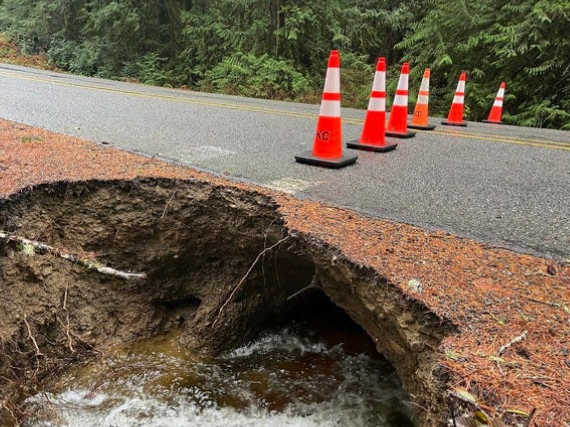
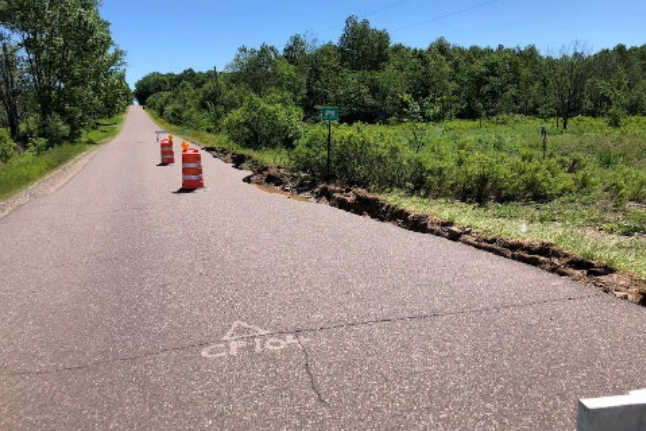
Photos of Damage
Photos of the damage prior to repairs being completed for Category A and C damages. It is helpful to also have photos of any Category B work.
EXAMPLE OF A COMPLETED DAMAGE DESCRIPTION
Location of Damage
GPS: 45.688169, -90.411482
Storms Road, Phillps, WI Approximately 1,373 ft south of the Storms Road and County Road W intersection.
Description of the Damage Incurred
Shoulder and roadway washed out along the west side of the road around the undermined and damaged culvert. During the flooding event that started on April 01, 2025, water washed out around the culvert causing it to be plugged with woody debris, mud and rocks from the stream. Culvert was fully functional prior to event. The shoulder gravel and paved road area materials were washed down into the ditch just to the west of the culvert.
Description of How Damage Will Be Repaired
The washed-out area had barricades place to close the road on April 02 when the washout was discovered by the Town patrolman. Temporary repairs of the road to re-open one lane started on April 02 to place gravel in the shoulder washout and were completed on April 03 with Town labor, equipment and gravel from the ditch and the town stockpile.
New culvert (24” x 40’ corrugated metal round) was ordered and delivered to the damaged location on April 15. Contractor A installed the culvert and performed the permanent repairs to the damaged section of the road other than the asphalt repairs. This allowed the road to be fully reopened and the Town picked up the barricades on April 15. Remaining debris was inside old culvert which was hauled away by Contractor A. Asphalt to be repaired by wedging by contractor later this construction season. New material will be placed at the location to replace the damaged section only.
Dimension of Damage
- Shoulder: 1050’ x 15’ x 1’ deep
- Asphalt: 30’ x 25’ x 2”
- Culvert: 24” x 40’ corrugated metal round
- Debris: wood, rocks and silt packed within the culvert.
- Gravel shoulder debris: 2000’ x 5’ x 0.75’
Cost Amount
- Category A costs: (included with temporary repairs of road and the removal of old damaged culvert)
- Category B costs:
- 4 hours overtime Town Labor for barrier placement and removal, and temporary road repairs. $120.00
- 2 hours usage of Town pickup truck. $33.16
- 6 hours removal of gravel from ditch with town skid steer usage: $235.32
- 3 hours usage of Town dump truck to haul gravel $205.561
- 5 Tons gravel from town stockpile – $135.00
- Category C costs:
- New Culvert: $1,250.00
- Culvert Installation and road repairs: $7,550.00
- Asphalt repair: $5,500.00 (estimate)
Total Costs for site: $15,029.04
Completion timeframe
The debris removal, culvert replacement and gravel repairs have been completed as of April 15. The outstanding asphalt repair will be completed later this construction season, the date is to be determined.
Photos of damage
Photos of the damage:
APPENDIX B – EM GRANTS PRO APPLICATION FLOW CHART
Flowchart of WDF Application Submittal and Review Process
Pro Step 1
Applicant creates the draft application, enters the actual and/or estimate costs and uploads Damage Assessment documentation. Then submits application.
Pro Step 2
WDF Coordinator reviews application for eligibility and completeness. When complete, then Coordinator advances application and outlines outstanding items. (60-day deadline)
Pro Step 3
Applicant receives notification to sign Assurances from system and signs.
Applicant updates any items listed by the WDF Coordinator including entering costs in full detail and uploads supporting documentation.
Applicant then Advances it to the Coordinator for review. (within 30-days of receipt)
Pro Step 4
WDF Coordinator reviews the final costs to validate information.
If additional information or correction is needed, WDF Coordinator sends back to applicant or sends note. (Repeat Pro Step 3)
Pro Step 5
Application costs validated.
WDF Coordinator notifies Applicant of final eligible costs and sends 1017 form for signature.
Applicant signs 1017.
WDF Coordinator requests reimbursement payment.
WDF Coordinator receives reimbursement notification.
WDF Coordinator mails check and sends payment notification to the applicant via email.
Applicant receives payment.
WDF Coordinator closes application.