
Revised 10/01/2024
This document is provided as a quick reference to the federal procurement standards and requirements for current and potential recipients or subrecipients of federal financial assistance provided by Wisconsin Emergency Management (WEM), a division of the Department of Military Affairs (DMA).
Federal requirements apply to the following grants:
- Grants awarded with federal funds (pass-through from WEM as a subgrant).
- Grants awarded with state funds that are used as cost share for a federally funded grant.
The Federal regulations referenced in this document do not cover state and tribal purchases guided by 2 CFR § 200.317, and the state and tribal procurement standards do not apply to non-state or non-tribal subrecipients.
The full federal requirements are available in Title 2 of the Code of Federal Regulations (2 CFR) published by the Office of Management and Budget (OMB) (https://www.ecfr.gov/current/title-2/subtitle-A/chapter-II/part-200/subpart-D#subject-group-ECFR45ddd4419ad436d). Grant programs may have specific guidance regarding procurement which can be found in the award terms and conditions for that program.
* The State of Wisconsin does not have state laws or regulations that apply to purchases by subrecipients unless otherwise stated in the Notice of Funding Opportunity or award terms and conditions. Local and tribal laws and regulations still apply. Refer to the grant agreement for a list of applicable requirements.
“The recipient or subrecipient must maintain and use documented procedures for procurement transactions under a Federal award or subaward, including for acquisition of property or services. These documented procurement procedures must be consistent with State*, local, and tribal laws and regulations and the standards identified in §§ 200.317 – 200.327.”
– Procurement Standards of 2 CFR § 200.318.
Procurement standards overview (The headings below are hyperlinked for navigation)
- Standards for all procurements (competitive & non-competitive)
- Procurement methods 2 CFR § 200.320
- Additional standards for competitive methods
- Other resources
STANDARDS FOR ALL PROCUREMENTS (COMPETITIVE & NON-COMPETITIVE)
General procurement standards.
2 CFR § 200.318
- Purchasing policy and procedures must be documented.
- Documented procedures must clearly cover conflict of interest policies and prevention.
- Must maintain oversight of the contractor’s performance. Unless specifically allowed in a grant, any costs associated with this requirement are not eligible under management and administration (M&A) costs awarded in the grant.
- All purchases must be necessary, reasonable, non-duplicative, and cost effective.
Contract provisions.
2 CFR § 200.327
A contract MUST include all provisions in Appendix II – Contract Provisions for Non-Federal Entity Contracts Under Federal Awards (https://www.ecfr.gov/current/title-2/subtitle-A/chapter-II/part-200/appendix-Appendix%20II%20to%20Part%20200).
Federal agency or pass-through entity review.
2 CFR § 200.325
Like all work and activity completed under a grant, all purchases and procurements MUST be properly documented as they are subject to review by both WEM and the federal agency.
Competition.
2 CFR § 200.319
All purchases MUST eliminate unfair competitive advantage, preferences, and/or a conflict of interest.
Socio-economic contracting.
2 CFR § 200.321
Socioeconomic contracting is a requirement where affirmative steps are taken to assure that minority-owned, woman-owned, veteran-owned, small businesses, and labor surplus area firms are used when possible. The affirmative steps MUST include the following:
- Placing qualified minority-owned, woman-owned, veteran-owned, and small businesses on solicitation lists.
- Assuring that minority-owned, woman-owned, veteran-owned, and small businesses are solicited whenever they are potential sources.
- Dividing total requirements, when economically feasible, into smaller tasks or quantities to permit maximum participation by minority-owned, woman-owned, veteran-owned, and small businesses.
- Establishing delivery schedules, where the requirements permit, which encourage participation by minority-owned, woman-owned, veteran-owned, and small businesses.
- Using the services and assistance, as appropriate, of such organizations as the Small Business Administration and the Minority Business Development Agency of the Department of Commerce.
- If subcontracts are allowed, the prime contractor is also required to take these affirmative steps.
Failure to carryout (or prove) these steps is frequently used as a justification to de-obligate funding by the Department of Homeland Security (DHS), Office of Inspector General (OIG). USE THE SMALL BUSINESS ADMINISTRATION’S “DYNAMIC SMALL BUSINESS SEARCH” (DSBS) TOOL TO FIND BUSINESSES TO SOLICIT https://dsbs.sba.gov/search/dsp_dsbs.cfm. Write a memo to document which three businesses were contacted, when the businesses were contacted, and whether an estimate/bid/proposal was submitted for the project.
Contract cost and price.
2 CFR § 200.324
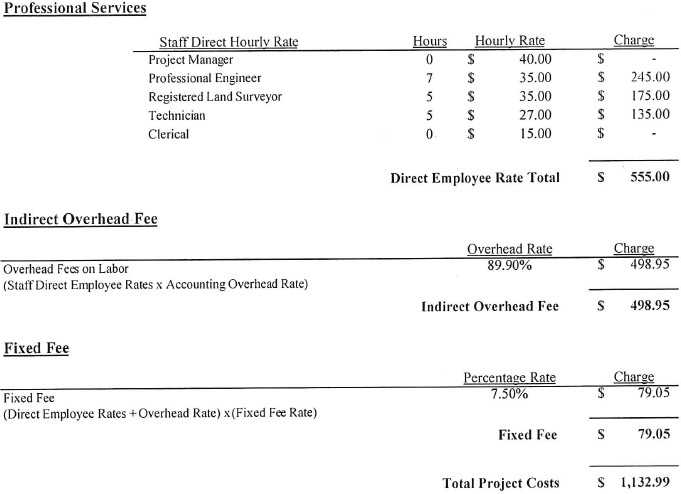
Cost-plus-percentage-of-cost contracts are prohibited because they provide no incentive for contractors to control costs – the more contractors charge, the more profit they make. A cost-plus-percentage-of-cost contract is a cost reimbursement contract containing elements that obligate the applicant to pay the contractor an amount (in the form of either profit or cost), which cannot be determined at the time the contract is made and will be incurred in the future. In other words, there are contracted costs for work performed, plus a commission based on a percentage of these future incurred costs.
See the example below. This contractor’s profit varies with the actual cost of performing the work. Total costs, including profit, are agreed to in negotiations prior to the work starting. The profit or “Fixed Fee” part of the invoice, highlighted in yellow, varies with the actual costs to perform the work. (Without looking at the specifics of the contract or purchase order, this cost would be deemed ineligible).
PROCUREMENT METHODS
2 CFR § 200.320
The procurement method is determined by the aggregate dollar amount for the item/service.
Non-competitive
Informal
$10,000.00* or less
“Micro-purchase”
2 CFR § 200.320(a)(1)
Formal
Emergency § 200.320(c)(3)
Single source § 200.320(c)(2)
Failed § 200.320(c)(5)
Competitive
Informal
$10,000.01* – $250,000.00
“Small purchase” or “Simplified bid”
2 CFR § 200.320(a)(2)
Formal
$250,000.01 or more
“Formal procurement”
2 CFR § 200.320(b)
Note: The federal micro-purchase threshold is found in 48 CFR § 2.101. The federal simplified acquisition threshold (SAT), which determines the threshold between a small purchase/ simplified bid and a formal procurement, is found in 48 CFR § 2.101.
*Exclusions apply based on type of purchase – refer to 48CFR§2.101“Micro-purchasethreshold”.
Micro-purchases.
2 CFR § 200.320(a)(1)
- To the extent practicable, must distribute micro-purchases equitably among qualified suppliers.
- May be awarded without soliciting quotes if the subrecipient considers the price reasonable.
Small purchases (a.k.a. simplified bids).
2 CFR § 200.320(a)(2)
Relatively simple and informal competitive procurement methods for securing services, supplies, or other property that does not cost more than the simplified acquisition threshold:
- Obtain a minimum of three (3) bids via phone, catalog, internet, fax, etc.
- The Office of Inspector General (OIG) requires three direct contacts to promote socioeconomic contracting. See Socio-economic contracting section in this document.
- Avoid sole source contracts unless a non-competitive procurement applies. See 2 CFR § 200.320(c) for more information.
Formal procurement.
2 CFR § 200.320(b)
- Requests for proposals and bids must be publicized and identify all evaluation factors and their relative importance.
- Adequate time must be given to provide potential bidders with a reasonable submission time.
- Must have written method for conducting technical evaluations of the proposals received and for selection of the contractor and/or vendor.
- A subrecipient should have written procedures for procurement transactions that help decide which type of formal method is used – Sealed Bid or Proposals.
Sealed Bids.
2 CFR § 200.320(b)(1)
This method is preferred for construction when sealed bidding is feasible and when certain conditions are present. A firm fixed price contract (lump sum or unit price) is awarded to the “responsible” bidder whose bid, conforming with all the material terms and conditions of the invitation for bids (IFB), is the lowest in price.
Proposals.
2 CFR § 200.320(b)(2)
This method is used when the sealed bid method is not feasible, usually when more than one source is expected to submit an offer and either a fixed-price or cost-reimbursement type contract is awarded, such as professional services like engineering, studies, surveying, etc. Proposals must be solicited from an adequate number of qualified sources, and three socio-economic business MUST be directly solicited. See Socio-economic contracting section in this document for more info.
ADDITIONAL STANDARDS FOR COMPETITIVE METHODS
Competition.
2 CFR § 200.319 (a)-(g)
All purchases of goods and services must eliminate unfair competitive advantage and preference. In addition, the bidding process must not demonstrate even the appearance of a conflict of interest. Contractors and individuals that help establish specifications or develop requests are prohibited from bidding. The process must not restrict competition, which includes avoiding the following:
- Placing unreasonable requirements or terms for potential bidders to qualify to do business.
- Requiring unnecessary experience and excessive bonding.
- Noncompetitive pricing practices between firms or between affiliated companies.
- Noncompetitive contracts to consultants that are on retainer contracts.
- Organizational conflicts of interest.
- Specifying a “brand name” product instead of allowing “an equal” product to be offered.
- Any arbitrary action in the procurement process.
- Use descriptions or other relevant requirements that unduly restrict competition.
Domestic preferences for procurements.
2 CFR § 200.322
To the greatest extent practical and consistent with law, both the subrecipient and the hired contractor are required to provide preference for goods and services produced in the United States. Federal grant subrecipients must follow the Build America, Buy America Act (BABAA) preferences.
BABAA only applies to …
- Federally funded or federally matched infrastructure projects.
- Articles, materials, and supplies that are consumed in, incorporated into, or affixed to an infrastructure project.
BABAA does not apply to …
- Non-infrastructure projects.
- Items brought to the construction site and removed at or before the completion of the infrastructure project, such as tools, equipment, and supplies, such as temporary scaffolding.
- Equipment and furnishings purchased that are used at or within the finished infrastructure project but are not an integral part of the structure or permanently affixed to the infrastructure project, such as movable chairs, desks, and portable computer equipment.
- Projects or programs for which the federal awarding agency has issued a waiver.
Procurement of recovered materials.
2 CFR § 200.323
When purchasing items greater than the micro-purchase threshold, the subrecipient and the contractor must comply with both the Solid Waste Disposal Act under Section 6002 and the Environmental Protection Agency (EPA) 40 CFR Part 247. Under these requirements:
- The item would contain the highest percentage of recovered materials practical.
- Preference favors solid waste management services that maximize energy and resource recovery.
- The subrecipient should include EPA guidelines and recovered materials in the procurement policies & procedures.
Bonding requirements.
2 CFR § 200.326
Only affects procurements relating to construction or facility improvement projects greater than the simplified acquisition threshold. WEM may accept the subrecipient’s bonding policy and requirements for construction or facility improvement contracts or subcontracts exceeding the simplified acquisition threshold. Reach out to the grant contact with questions.
OTHER RESOURCES
State of Wisconsin law
State law regarding procurement is under Wisconsin Statute (Wis. Stat.) Chapter 16. State law applicable to subrecipients is found under Wis. Stat. §16.73 Cooperative purchasing.
Technical assistance
The Department of Homeland Security (DHS), Federal Emergency Management Administration (FEMA) offers procurement guidance and free trainings for recipients and subrecipients on their website https://www.fema.gov/grants/procurement.
Under Wis. Stat. § 16.73(3), the State of Wisconsin’s Department of Administration (DOA) is able, upon request, to provide technical purchasing information such as standard forms, manuals, product specifications, standards, and contract templates.
State and tribal procurement standards vs. WEM subrecipients
Applicability of federal procurement requirements
§ 200.317 Procurements by States and Indian Tribes.
- States and Tribes: Yes
- WEM Subrecipients: No
§ 200.318 General procurement standards.
- States and Tribes: No
- WEM Subrecipients: Yes
§ 200.319 Competition.
- States and Tribes: No
- WEM Subrecipients: Yes
§ 200.320 Procurement methods.
- States and Tribes: No
- WEM Subrecipients: Yes
§ 200.321 Contracting with small businesses, minority businesses, women’s business enterprises, veteran-owned businesses, and labor surplus area firms.
- States and Tribes: No
- WEM Subrecipients: No
§ 200.322 Domestic preferences for procurements.
- States and Tribes: No
- WEM Subrecipients: No
§ 200.323 Procurement of recovered materials.
- States and Tribes: No
- WEM Subrecipients: No
§ 200.324 Contract cost and price.
- States and Tribes: No
- WEM Subrecipients: Yes
§ 200.325 Federal agency or pass-through entity review.
- States and Tribes: No
- WEM Subrecipients: Yes
§ 200.326 Bonding requirements.
- States and Tribes: No
- WEM Subrecipients: Yes
§ 200.327 Contract provisions.
- States and Tribes: Yes
- WEM Subrecipients: Yes
Appendix II Contract provisions.
- States and Tribes: Yes
- WEM Subrecipients: Yes