This newsletter is a joint venture between a workgroup of Wisconsin Emergency Management (WEM) and statewide county emergency management representatives. This workgroup was formed to provide guidance and training to Local Emergency Planning Committees (LEPC), as they work to reenergize and improve participation in emergency planning in their communities.
Radiological Response
A radiological response in emergency management focuses on life safety, incident stabilization, public protection, and coordinated recovery. The overall approach is similar to other hazardous materials incidents, but with added emphasis on radiation assessment, protective action decisions, contamination control, and public messaging.
Core Response Priorities include:
- Protect Life First: Rescue, medical care, fire suppression, and immediate hazard control come before detailed radiation measurement.
- Establish Command & Coordination: Activate ICS, determine whether the EOC should monitor, partially activate, or fully activate, and set operational objectives.
- Access the hazard: Identify the source, affected area, likely exposure pathways, weather impacts, and whether contamination is spreading.
- Protect the Public: Use evacuation, shelter-in-place, access control, and controlled movement based on the situation and technical guidance.
- Protect Responders: Brief personnel, control entry, track exposure, use appropriate PPE, and apply dose management principles.
- Control Contamination: Isolate contaminated people, equipment, and areas; conduct monitoring and decontamination in a controlled process.
- Coordinate Recovery Early: Plan for re-entry, relocation, public health follow-up, debris and waste issues, and long-term community impacts.
Grant Deadlines & Upcoming Funding
- 2026 HMEP Grants
- Grant Period April 20, 2026 – August 31, 2026
- Closeout Reports Due September 30, 2026
- 2026 Computer & HazMat Equipment Grant (CHREG)
- NOFO July 6, 2026
- Application Due July 31, 2026
Training/Conference
- WEMA Conference, September 23-24, 2026 – Stevens Point, WI Registration Preconference training will be held on September 22nd.
- NEMA Annual Forum – October 19-22, 2026 – Little Rock, AR NEMA Annual Forum Save-the-Date
- IAEM Conference – November 6-12, 2026 – Long Beach, CA IAEM Conference Registration
- NASTTPO Mid-Year Conference – October 26-28 – Rogers, AR NASTTPO Registration Link
- FEMA’s Center for Domestic Preparedness has a number of training opportunities, including HazMat, at the Anniston, AL campus. Learn more at CDP.
Resources
Printing EPCRA Off-Site Response Plans
Printing EPCRA Off-Site Response Plans is beneficial because it gives responders and coordinators a dependable, immediately accessible backup copy of critical hazardous materials planning information. Printed plans support continuity, field usability, responder distribution, and operational readiness.
Key Benefits of have printed Off-Site Response Plans
- Reliable access during incidents: A printed plan is available even if power, networks, or software systems are down.
- Faster field reference: Responders can quickly check facility hazards, contacts, notification procedures, and evacuation information without needing to log into a system.
- Better distribution to operational users: Printed copies can support that distribution in apparatus, stations, and duty locations.
- Improved coordination: Off-site plans are built to support facility identification, response procedures, emergency coordination, public notification, and evacuation planning, all of which are easier to reference quickly in a hard-copy format during a fast-moving event.
- Support for public-access and recordkeeping expectations: EPCRA requires emergency response plans to be available at designated locations during normal working hours, and FEMA doctrine emphasizes plan distribution and maintaining records of who received the plan. Printed copies can help support those access and dissemination practices.
- Useful backup for dispatch and EOC operations: Hard copies can serve as a dependable backup source for dispatchers,
In the News
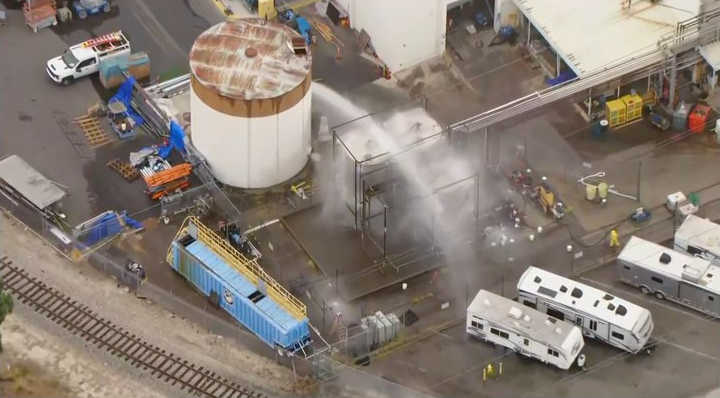
Evacuation Orders of 50,000 people were issued during a hazmat incident at an aerospace facility in Garden Grove, CA, not far from Disney Land. Attempts to ward off a tank explosion was successful after a crack developed in the tank. See more with Fox News here.
Important Note on the WHOPRS Website Disclaimer
On the WHOPRS Website Log-in page you will see a new disclaimer under the Help Desk toward the bottom of the page. The disclaimer states, “This website is not supported 24/7 and should not be used as an emergency response tool. The information available on this website is for planning purposes only. Information on this website is self-reported by regulated facilities and planners, and no representation is made or implied regarding the accuracy, validity, reliability, availability, or completeness of any information on the website.”
The program was developed for EPCRA reporting requirements and should serve as a planning tool versus a response tool.
EPA Renewed Interest is EHS at Ice Arenas/Rinks
The EPA is looking for help in identifying Ice Rinks and Ice Arenas that have EHS on site. If you have not locally reached out to your rinks and arena, it is highly encouraged. Many rinks/arenas are run by volunteers, who have no knowledge of EPCRA or it’s mandatory reporting requirements.
Many newer rinks/arenas use some form of glycol but older systems, that use ammonia, are still in place. When they go unreported the community has no idea of this risk in their community.
This Newsletter is issued quarterly to bring ideas and information for helping your LEPC and energizing them in your county.
The next issue will be released in September 2026. If you have ideas that you would like to share, please reach out to Darlene Pintarro. Let’s work together here in Wisconsin!
Did You Know?
The Everything EPCRA Roll-out has been complete. Valuable feedback was submitted by participants to update training modules so that the training can be valuable to all. Please keep an eye out for future training opportunities with this series. Participants can take all of the eight modules or sign up for individual modules.