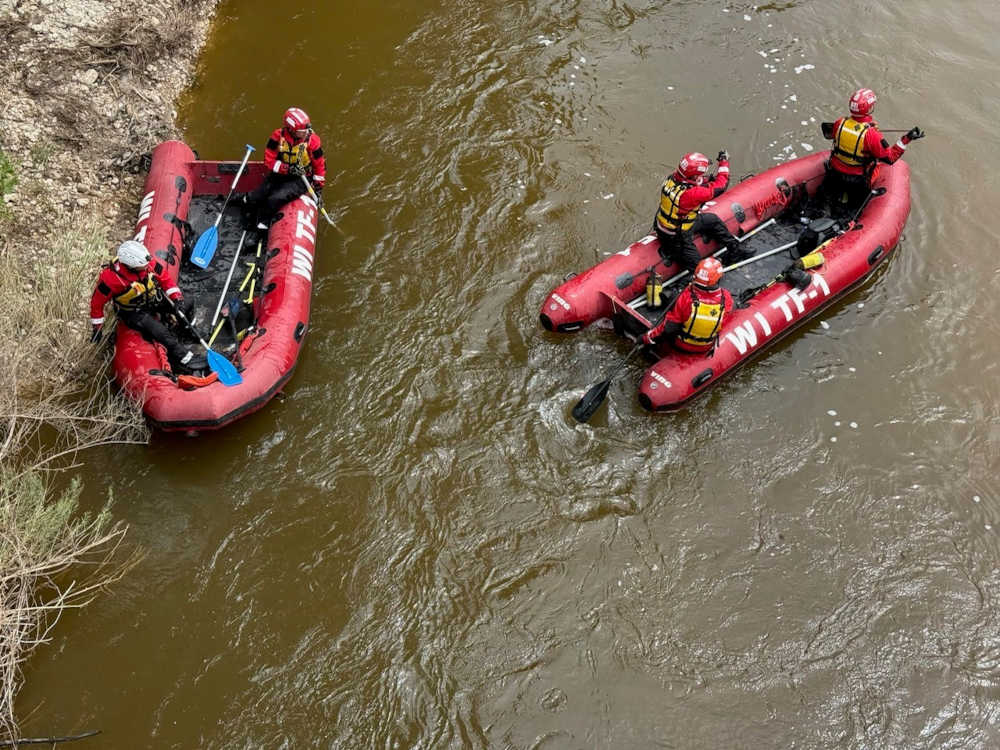
Response begins the moment a disaster occurs. It involves immediate actions to save lives, protect property, and meet basic human needs. From first responders providing aid to emergency shelters opening their doors, this phase is about mobilizing resources and coordinating efforts to stabilize the situation.
Emergency Fire Services
Wisconsin Emergency Management has works with the Wisconsin State Fire Chiefs Association and the Mutual Aid Box Alarm System-Wisconsin (MABAS-WI) to implement the state’s fire service emergency response plan (PDF Download). The plan provides a framework for fire services resource deployment.
MABAS-WI is a statewide mutual system aid system for fire, rescue, emergency medical services, and associated special operational services.
Emergency Police Services
Program History
When a tornado tears through a community or a disturbance occurs at a prison, the situation can overwhelm local law enforcement. That is why Wisconsin has the Emergency Police Services (EPS) Program to provide law enforcement support and coordination of mutual aid in times of crisis.
The EPS program dates back to 1961, when President Kennedy ordered states and the federal government to update emergency plans and procedures to respond to a national crisis as there was a looming threat of nuclear war. As part of the Civil Defense initiative, the Emergency Police Services Program was created.
The federal guidance was specific, the EPS program coordinator would be involved in wartime planning and natural disaster support functions only. The program emphasized training auxiliary police to assist local law enforcement in the event of a nuclear war or other major catastrophes.
By the late 1960’s, the position had changed and became more response oriented to events that were happening in the state such as campus rioting and strikes as oppose to purely planning for war. Wisconsin sheriffs and police chiefs realized that in very serious events whether it was a riot on campus, flooding or a state employee strike, they did not have enough resources to respond. The State of Wisconsin Emergency Operations Plan was updated to add procedures on mobilizing additional law enforcement resources in times of emergencies through the EPS Program.
As the EPS program changed, the coordinator position changed as well. The EPS coordinator was originally part of the Wisconsin Motor Vehicles Department and later moved over to Emergency Government. The Governor-Appointed Administrator of the State Emergency Government Agency was to serve also as EPS Director.
In addition, an EPS Deputy Director was created. The Deputy Director is a civil service position with a background in law enforcement. The EPS Deputy Director oversees the daily program activities and works closely with local law enforcement.
As part of the EPS program, the state was divided up into regions with a sheriff elected by fellow sheriffs to serve as volunteer police services director for a specific area. That director would also appoint a police chief and a sheriff to serve as alternate or deputy area directors. Today, the state has seven EPS areas and elections are held every four years.
In the event of an emergency, the area director works with the State EPS Deputy Director in setting up a mutual aid response with local, state and federal law enforcement agencies to provide requested resources. The initiating county sheriff maintains the authority over the situation and the response is to augment their forces with law enforcement officers from surrounding areas.
In the event of an emergency, the area director works with the State EPS Deputy Director in setting up a mutual aid response with local, state and federal law enforcement agencies to provide requested resources. The initiating county sheriff maintains the authority over the situation and the response is to augment their forces with law enforcement officers from surrounding areas.
In recent years, the EPS program has provided support following major disasters. EPS mutual aid was used to coordinate additional officers to help provide traffic control and other assistance in Ladysmith for seven days following the F3 tornado in September 2002.
EPS program also provided law enforcement mutual aid following the Siren tornado in 2001, the Weyauwega train derailment in 1996, and Spear fishing in the 1980’s. In Weyauwega, more than 70 additional law enforcement officers were used on 12-hour shifts for 21 days to assist the Waupaca County Sheriff’s Department.
The requesting agency is responsible for the cost of the operation. However in many cases the state and federal government has reimbursed the local governments in the events such as flooding and tornadoes.
Related Links
- Wisconsin State Patrol
- Badger State Sheriff’s Association
- Wisconsin Chiefs of Police Association
- Wisconsin Department of Natural Resources
- Wisconsin Department of Justice
- USA Cops – Wisconsin Sheriff’s Offices
- USA Cops – Wisconsin Police Departments
- Wisconsin Legislature – Legislative Documents Search
Regional Offices
Region Directors serve as the Wisconsin Emergency Management representative in all emergency management issues at the regional level by managing, directing, coordinating and monitoring a variety of programs including those of the Division, other state agencies as well as county municipal and tribal agencies.
The Region Directors and Office Operations Associates work with County and Tribal Directors on all phases of emergency management – Preparedness, Response, Recovery and Mitigation, as they plan for and react to natural and man made disasters.
Northwest Region
Brian Cockerham
Northwest Regional Director
brian.cockerham@widma.gov
608-516-5283
Counties in this Region:
- Ashland
- Barron
- Bayfield
- Burnett
- Douglas
- Iron
- Polk
- Price
- Rusk
- Sawyer
- Washburn
Northeast Region
Teresa Erler
Northeast Regional Director
teresa.erler@widma.gov
715-845-9517
Counties in this Region:
- Florence
- Forest
- Langlade
- Lincoln
- Marathon
- Marinette
- Menominee
- Oconto
- Oneida
- Portage
- Shawano
- Vilas
- Wood
Northeast Region
Janell Rucinski
Northeast Office Operations Associate
janell.rucinski@widma.gov
715-845-9517
Counties in this Region:
- Florence
- Forest
- Langlade
- Lincoln
- Marathon
- Marinette
- Menominee
- Oconto
- Oneida
- Portage
- Shawano
- Vilas
- Wood
West Central Region
Lisa Olson-McDonald
West Central Regional Director
lisa.olsonmcdonald@widma.gov
715-839-3825
Counties in this Region:
- Dunn
- Buffalo
- Chippewa
- Clark
- Eau Claire
- Jackson
- La Crosse
- Monroe
- Pepin
- Pierce
- St. Croix
- Taylor
- Trempealeau
West Central Region
Lacey Donatell
West Central Office Operations Associate
lacey.donatell@widma.gov
715-839-3825
Counties in this Region:
- Dunn
- Buffalo
- Chippewa
- Clark
- Eau Claire
- Jackson
- La Crosse
- Monroe
- Pepin
- Pierce
- St. Croix
- Taylor
- Trempealeau
Southwest Region
Darin Gudgeon
Southwest Regional Director
darin.gudgeon@widma.gov
608-516-0296
Counties in this Region:
- Adams
- Columbia
- Crawford
- Dane
- Grant
- Green
- Iowa
- Juneau
- Lafayette
- Richland
- Rock
- Sauk
- Vernon
East Central Region
Steve Fenske
East Central Regional Director
steve.fenske@widma.gov
920-929-3730
Counties in this Region:
- Brown
- Calumet
- Dodge
- Door
- Fond du Lac
- Green Lake
- Kewaunee
- Manitowoc
- Marquette
- Outagamie
- Sheboygan
- Waupaca
- Waushara
- Winnebago
Southeast Region
Ben Schliesman
Southeast Regional Director
ben.schliesman@widma.gov
262-782-1515
Counties in this Region:
- Jefferson
- Kenosha
- Ozaukee
- Racine
- Washington
- Milwaukee
- Waukesha
- Walworth
Southeast Region
Mary Zahn
Southeast Region Office Operations Associate
mary.zahn@widma.gov
262-782-1515
Counties in this Region:
- Jefferson
- Kenosha
- Ozaukee
- Racine
- Washington
- Milwaukee
- Waukesha
- Walworth
Response Teams
Aligned Law Enforcement Response Teams
Aligned Law Enforcement Response Teams
The Aligned Law Enforcement Response Team (ALERT) is funded through Homeland Security and comprised of specialized teams of law enforcement professionals to deliver enhanced capabilities, tactics, and specialized equipment in high-risk situations with SWAT, Bomb Squads, and/or Dive Teams.
ALERT has two missions:
- The primary mission is to establish, manage, and sustain high operational standards and qualifications, enabling its personnel to operate effectively with specialized equipment and through highly coordinated tactical efforts that exceed the capabilities of most individual law enforcement agencies.
- The secondary mission of ALERT is to provide specialized equipment and enhanced operational capabilities during critical incidents, as well as deploy expertly trained officers in response to a formal mutual aid request initiated by another law enforcement agency, in accordance with established mutual aid protocols.
As of 2025, There are 486 personnel encompassing nine regional SWAT Teams, six regional Dive Teams, and five Bomb Squads that have signed agreements to participate. They have responded to 1093 calls with more than 18,000 personnel hours.
Wisconsin Complex All-Hazard Incident Management Team
The Wisconsin Complex All-Hazard Incident Management Team (AHIMT) is a multi-agency, multi-jurisdiction team for extended all-risk incidents. The Team’s approach is to successfully support or manage major incidents requiring a significant number of local, regional, state and possibly federal resources. This could include incidents such as tornadoes, earthquakes, fires, floods, search and rescue, multi-day situations or planned mass-gathering events. The purpose of the AHIMT is to assist any jurisdiction confronted with an incident beyond its capabilities in either complexity or duration. The AHIMT is staffed by qualified personnel covering 16 different organizational functions. Team members come from a broad cross section of disciplines including: law enforcement, fire, EMS, public works, emergency management, public health, finance, forestry, general administration and much more. Members are required to maintain a certain level of base and advanced training, qualifications and experience through their home agency. The Team is a modular organization that can expand or contract its organizational structure and staffing based on the request of the local jurisdiction. Under Incident Command, deployment of a standard team includes Safety, Liaison, Public Information, Finance, Planning, Operations and Logistics. More staff positions are available if needed.
Other services available from the team:
- Incident safety
- Resource coordination & tracking
- Volunteer coordination
- Event planning
- Logistical services & supply needs
- Mapping & technical support
- Communication needs
- Public information coordination
- Financial tracking
Wisconsin Cyber Response Team
800-943-0003 Option 2
The Wisconsin Cyber Response Team (CRT) is a volunteer emergency response group administered by Wisconsin Emergency Management and facilitated through the Department of Military Affairs. Comprised of cybersecurity and information technology professionals at the ready, the CRT supports public-sector critical infrastructure and local government organizations in the event of a cyber incident within the State of Wisconsin. Services and support by Wisconsin Emergency Management and the Wisconsin CRT includes:
Pre-Incident services provided by and the Wisconsin Cyber Response Team Include:
- Cybersecurity Preparedness Planning
- Incident Response Planning Guidance
- Exercise Development and Support
- Quarterly, Monthly, and Annual training – including live cyber range exercises.
- Risk and Vulnerability Assessments (CISA-Cyber Security Evaluation Tool (CSET) instruments to include Cybersecurity Performance Goal (CPG), Ransomware Readiness Assessment (RRA), Cybersecurity Resilience Review (CRR), External Dependencies Management (EDM), Penetration Testing (internal and external).
Incident Response Support includes:
- Incident Triage / Scoping
- Remote digital forensics analysis
- On-site incident response
- Incident Command System and All-Hazards consequence management and integration
Wisconsin CRT support and services are provided to local public-sector entities and CISA-designated critical infrastructure/key resources at no cost. Supported entities include:
- County/Tribal Governments
- Municipalities
- Public/private K-12 schools and libraries
- Public utilities
- Healthcare facilities
NEED INCIDENT RESPONSE SUPPORT?
To request the Wisconsin Cyber Response Team for supporting a cybersecurity incident, call 800-943-0003 Option 2
Qualifications
The Wisconsin CRT seeks volunteers who have experience in all areas of cybersecurity preparedness, mitigation, response, and recovery. Some individuals may, through industry experience have the skills to serve in come capacity beneficial to reducing Wisconsin’s overall cybersecurity risk. Therefore, a willingness to volunteer to serve public-sector entities is foundational to our team. The CRT facilitates a quarterly cybersecurity training program to members to assist in establishing, developing, and mentoring to acquaint members with the tools and skills needed to respond to cyber incidents statewide.
Application Process
The Wisconsin Cyber Response Team (CRT) seeks qualified incident response practitioners with expertise in addressing cybersecurity events/incidents to apply for membership. The Wisconsin CRT accepts applications during two open application periods: December 1-31 and June 1-30. If you are interested in joining the Wisconsin CRT, email CRT@widma.gov
NOTE: Incident Responders must agree to become InfraGard members or provide a TSA Known Traveler Number as evidence of a background investigation.
Mission
To provide support for critical infrastructure in the state of Wisconsin in order to prevent, mitigate, and respond to cyber incidents through assessments, training, and incident response.
Vision
Coordinated response effort from the Wisconsin volunteer Cyber Response Team (CRT) and National Guard, assisting in both preventing and responding effectively in the event of an emergency.
Member of the Wisconsin CRT continue to develop skills in a variety of practical application such as:
- Incident Response Planning
- Incident Handling
- Digital Forensics Analysis
- Network Security Hardening / Defense-in-Depth
- Professional Networking, Mentoring, and Leadership Development
To join the CRT, please click Here. For other inquiries, please contact the CRT at CRT@Widma.gov.
Membership Tiers
General Member: General Membership entitles volunteers to participate in the CRT’s unclassified information-sharing network, participate in monthly collaboration calls, the CRT Foundations Seminar, and Skills training.
Incident Responder: In addition to the General Member items listed above, Incident Responders must sign a non-disclosure agreement and provide an annual reapplication to update member data. All CRT Incident Responders must adhere to a code of ethics requirement to refrain from any activities that may present a real or perceived conflict of interest while working in a state emergency volunteer capacity.
Affiliate Member: Serving as a short-term, case-by-case special category, the purpose of CRT Affiliate is to allow a broader range of people to take advantage of some CRT training activities that assist in the reduction of the state’s cybersecurity risk. Affiliate membership ends when the sponsoring CRT member notifies Wisconsin Emergency Management that the internship or student status has ended. For students, once students graduate and are employed full-time in the IT/Cybersecurity Industry, they may apply for General Membership. CRT Affiliate members are NOT eligible for Homeland Security Grant Funded training vouchers. Affiliate CRT members include:
- Students enrolled in an accredited Wisconsin college, university, or technical college and officially working under supervision of an existing CRT member. [Note: Student affiliate members must be at least 18 years old]
- Cybersecurity professional residing in a state other than Wisconsin serving in a professional cybersecurity capacity whose knowledge, skills, and experience supports the Wisconsin CRT. Examples of CRT Affiliate Members in this context include interstate civilian cyber reserve personnel (e.g other state’s cyber response teams, Civilian Reserve-ISAC) or other cybersecurity professionals providing program development guidance.
Wisconsin Hazardous Materials Response System
The statewide Wisconsin Hazardous Material Response System (WHMRS) is intended to assist communities (or regions) who have been overwhelmed by the effects of a hazardous material emergency/release by providing specialized hazardous material resources to aid the stricken communities in incident stabilization and hazard mitigation activities. The focus of the statewide system is to provide quick strike capability to ensure incident assessment, stabilization, and mitigation, thus reducing the threat to the public, responders, and the environment. To provide a high level of hazardous materials response capabilities to local communities, Wisconsin Emergency Management contracts and manages twenty-one Regional Hazardous Materials Response Teams. The teams are divided into Task Forces: Northeast Task Force, Northwest Task Force, Southeast Task Force, and the Southwest Task Force. These Task Forces are then divided into Type I, Type II, and Type III teams, all with complimentary capabilities and training requirements. The WHMRS may be activated for an incident involving a hazardous materials spill, leak, explosion, injury or the potential of immediate threat to life, the environment, or property. The WHMRS responds to the most serious of spills and releases requiring the highest level of skin and respiratory protective gear. This includes all chemical, biological, or radiological emergencies. Several counties have Type 4 Hazardous Materials Response Teams. These county teams respond to chemical incidents which exceed the capabilities of local fire departments but do not require the specialized training or equipment of WHMRS teams. County teams may also provide assistance to surrounding counties.
Wisconsin’s Urban Search and Rescue Task Force
Wisconsin’s Urban Search and Rescue Task Force (WI-TF1) is a team of individuals specializing in urban hazard mitigation, search and rescue, and incident stabilization. While their emphasis is the location and extrication of victims trapped in collapsed structures or confined spaces, the task force is capable of responding to state and national disasters including earthquakes, hurricanes, tornadoes, floods, and man-made technological and terrorist events. WI-TF1 is a response asset owned and managed by Wisconsin Emergency Management (WEM), funded through federal Homeland Security funds.
WI-TF1 is comprised of more than 140 highly-trained personnel including structural engineers, canine handlers, technical search specialists, doctors, and advanced rescue personnel. Many of the members of WI-TF1 are firefighters with local fire departments that have an agreement with WEM to make their personnel available for training and deployment. The participating fire departments are reimbursed by the State when their personnel are participating in WI-TF1 activities. There are currently eleven fire departments that have agreements with WEM for participation on the task force. These are: Antigo, Appleton, Beloit, Chippewa Falls, Green Bay, Janesville, La Crosse, Menomonie, Neenah-Menasha, Oshkosh, and Superior. A number of instructors and other personnel assigned to the Regional Emergency All Climate Training (REACT) Center are also members of the Task Force or provide support services.